Web Log
The $350 Billion "Text Tax": How Unstructured Notes Are Bankrupting American Healthcare
9/11/2026 7:19 PM
The $350 Billion "Text Tax": How Unstructured Notes Are Bankrupting American Healthcare
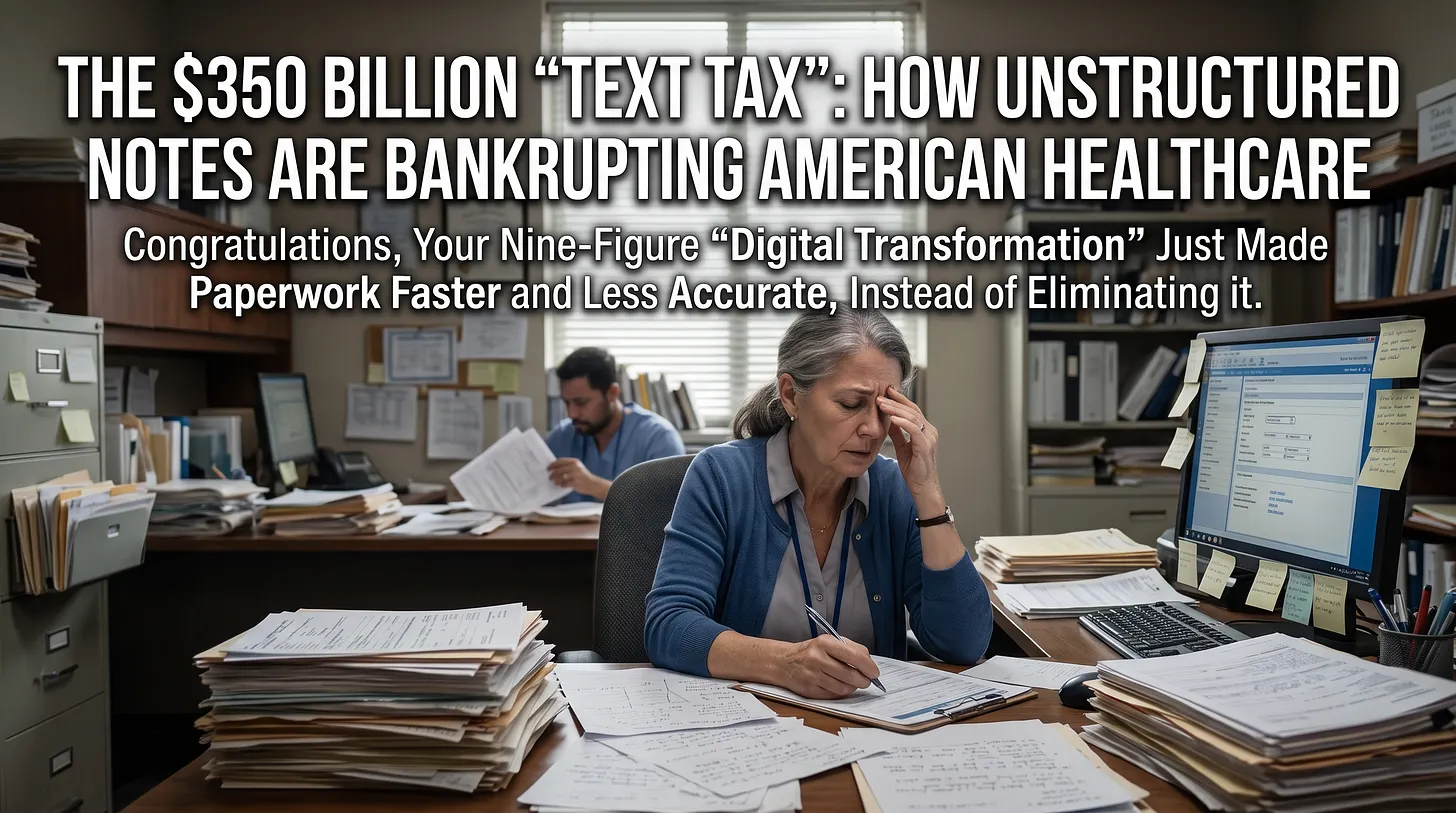
Congratulations, Your Nine-Figure “Digital Transformation” Didn’t Eliminate Paperwork, It Just Made It Faster and Less Accurate.
Introduction
The $350 billion administrative tax strangling American healthcare is not caused by inefficient billing departments, greedy insurance middlemen, or overly complex coding rules. Those are merely the symptoms.
The actual disease is text.
Medicine’s original architectural sin was adopting narrative prose as its primary data storage format. Text is an analog container disguised as a digital file. It locks clinical information inside unsearchable paragraphs, forcing a multi-hundred-billion-dollar industry of scribes, medical coders, billing clerks, auditors, and claims adjusters to exist solely to translate narrative sentences into actionable database records.
Whether a clinical note is handwritten, typed into a modern EHR, processed by a human or AI scribe, or passed through a speech-to-text transcription service, the result is functionally identical: unstructured narrative text. You just do not get ink-stained fingers. As long as healthcare relies on narrative prose to record encounters, every digital "fix"—from endless drop-down menus to predictive generative AI—will fail. This is also the main cause of physician burnout. You cannot cure a structural and administrative crisis until you eradicate the disease that causes it: text itself.
The Situation
Healthcare in the United States is buckling under an administrative crisis driven largely by broken technology. Hospitals spend up to a quarter of their operational budgets on revenue cycle management (RCM), medical coding, and fighting insurance claim denials. Physicians and nurses spend hours every night in "pajama time," manually typing or dictating notes and clicking through thousands of drop-down menus to satisfy third-party billing audits. That does not include the hundreds of millions paid to the legacy EMR vendor
Meanwhile, small community and rural facilities are closing at an unprecedented rate because they cannot afford multi-hundred-million dollar software implementations, nor can they survive the 30 to 90 day payment delays imposed by commercial insurance carriers. The root cause is not a lack of clinical skill; it is an architectural failure. Healthcare software was built around spreadsheet-style billing paperwork rather than clinical efficiency or natively structured data.
Legacy platforms like Epic and Oracle Health (formerly Cerner) represent the ultimate cautionary tales of this architectural trap:
- Epic Systems (No Database at All): Epic does not use a database in the modern sense. It runs on Chronicles, a proprietary storage engine built on top of InterSystems Caché/IRIS, which is fundamentally derived from MUMPS (technology created in the late 1960s). MUMPS is a flat, hierarchical key-value tree structure designed for multi-user string manipulation on limited hardware. It completely lacks relational schema enforcement, SQL querying capabilities, foreign key integrity, or native object structures. Because it cannot natively query clinical concepts across patients, Epic layers thousands of text fields and drop-down menus over these hierarchical trees. Searching clinical data across a population requires extracting data out of Chronicles and pumping it into secondary relational reporting databases like Clarity or Caboodle, creating massive data latency and multi-million dollar infrastructure overhead. To make this work, Epic wrote the same core software over 130 times to cater to 130 different medical specialties, resulting in bloated installations costing hundreds of millions, or even over a billion dollars.
- Oracle Health (Cerner): Cerner attempted to build on traditional relational databases, but architected its schema around decades of non-normalized, disconnected tables. This creates extreme complexity just to display a single patient event. The underlying mess forced Oracle into a multi-billion dollar rewrite that drains engineering resources, delivers little immediate clinical value, and stalls product evolution. We have posited that this rewrite will be the demise of Oracle.
Logical Outcome
The healthcare industry treats narrative text notes as a digital advancement, but narrative text is no better than paper. Whether a clinical note is handwritten, typed into a word processor, recorded by a medical transcriptionist, or whispered to a human or AI scribe, the result is identical: unstructured narrative text. You just don’t get ink-stained fingers.
A narrative note, regardless of how it was captured, locks clinical data inside unstructured prose. It cannot be searched, it cannot be queried, and it cannot generate a real-time operational report. Human transcriptionists and AI scribes do not solve this problem; they simply shift the keyboard tax from the doctor to another employee while leaving the data just as trapped and useless as if it were written on a legal pad.
This reliance on narrative text, manual transcription, and scribes is bleeding the healthcare system dry. Studies show that administrative documentation, billing management, transcription services, and human scribes consume upwards of $350 billion annually in direct overhead. When combined with the $4.6 billion spent each year addressing physician burnout, lost productivity, and turnover caused by documentation burdens, the true cost of processing unstructured text reaches hundreds of billions of dollars every year.
This massive, unnecessary financial drain directly inflates the cost of care for patients, starves rural hospitals of operating cash, and threatens the total economic collapse of the entire medical system.
Short Answer
Modern attempts to fix healthcare software fail because they still rely on manual data entry, typing, or external software layers. Frameworks like openEHR lack a usable interface out of the box, forcing organizations to build custom software. EMRs like Canvas Medical force clinicians to type syntax commands into text fields, while systems like Elation Health remain tethered to specialty-specific primary care templates and endless drop-down menus.
Sentia Health solves the crisis by eliminating manual data entry, templates, and specialty software modules. The clinician simply pushes a "Start Speaking" button to dictate observations directly during the encounter. Sentia maps that voice input natively into the National Institutes of Health’s Unified Medical Language System (UMLS).
By storing clinical concepts as native structured data objects, Sentia eliminates manual coding, destroys the need for traditional revenue cycle management, and enables automated, real-time health coverage that settles payments instantly upon care delivery.
The Slightly Longer Answer
1. Specific Flaws in Alternative Modern Systems
To understand why a true native data architecture is rare, it is necessary to evaluate current alternative approaches and the specific flaws in each:
openEHR: A Framework Without a Front End
- The Structural Flaw: openEHR is an open-source data specification framework, not a working software product. You cannot buy openEHR and install it in a clinic to chart a patient encounter.
- The Usability Flaw: openEHR completely fails to solve the clinician data entry problem. It provides no user interface, no dictation engine, and no direct access layer for doctors. Physicians cannot interact directly with database APIs. To use openEHR, a hospital must spend millions of dollars and years of engineering time building custom front-end software applications from scratch on top of the specification.
- Still need medical coding: …and all the monkey motion the traditional insurance company puts the practitioner through to get paid for work already performed.
Canvas Medical: Rebranding Typing as "Commands"
- The UX Flaw: Canvas attempts to structure data using a "command-driven" charting model where clinicians type inline slash-commands (like /diagnose or /prescribe). Typing a command into a command-line interface is still typing into a system. It does not eliminate administrative data entry; it merely rebrands it.
- The Search Flaw: Canvas enforces strict database ontology lookups. If a clinician makes a typo or enters a natural clinical phrase, the system fails to match the concept, forcing the doctor to stop, backspace, and re-type the exact search string until the database concept appears.
Elation Health: Tethered to Primary Care Specialties
- The Architectural Flaw: Elation advertises flexibility, but it remains heavily tailored to a specific medical domain: primary care.
- The Data Entry Flaw: Data entry in Elation is still a trainwreck of specialty templates, drop-down forms, and custom modules. It adapts traditional form-filling interfaces to primary care rather than eliminating specialty modules and forms altogether.
2. The Sentia Health Architecture: Push-to-Talk Universal Data Capture
Sentia Health eliminates the core trade-off between clinical ease of use and structured database capture. Instead of forcing clinicians to type commands, navigate drop-down forms, or rely on ambient listening tools that record reams of irrelevant background chatter, Sentia uses a precise push-to-talk workflow.
The clinician simply clicks the "Start Speaking" button when ready to record an observation, statement, or conclusion. This ensures the system captures clean, intentional clinical input without clogging the database with extraneous conversational noise.
The voice input is processed by a deterministic engine that maps spoken clinical observations directly into the Unified Medical Language System (UMLS) maintained by the NIH. Because UMLS contains every medical concept across every domain, there is no need to write or configure separate software modules for 130 different specialties. A primary care doctor and a cardiothoracic surgeon dictate into the exact same underlying architecture.
Each encounter is automatically converted and saved natively across four outputs:
- Raw Audio: Original voice recording for audit compliance.
- Transcript: Clean, readable text.
- JSON Objects: Immutable, portable data structures ready for API integration.
- Clinical Treeview: Hierarchical representations of clinical data.
Furthermore, Sentia transfers data using a lightweight six-property object, completely bypassing bloated legacy standards like HL7 and FHIR. It decouples patient demographic data from binary imaging files, eliminating the privacy flaws of DICOM headers while ensuring instant semantic interoperability across any healthcare environment.
3. Automating the Health Insurance Industry via Native Structured Data
The most transformative aspect of native structured data is not just fixing the chart; it is the total automation of health insurance.
Traditional commercial health insurance is an expensive, archaic middleman, designed in the 1600s. Insurers take 15 to 20 percent off the top of every healthcare dollar to run manual claims adjudication, maintain armies of medical coders, enforce prior authorizations, and issue arbitrary care denials. They hold provider payments for 30 to 180 days to earn interest float on capital while rural hospitals starve for cash. That does not include the funds the practice or hospital has to spend to satisfy insurance’s insane requirements. We estimate that the total cost for using legacy insurance is on the order of 65 percent waste.
With Sentia, a hospital or practice does not have to abandon its legacy billing and software environment overnight. Sentia operates seamlessly alongside existing legacy tools, processing traditional billing where necessary, until the patient population is fully transitioned over to the modern Sentia ecosystem.
Once a patient is on this modern platform, the document-procedure-claim cycle is replaced by instant document-procedure-settlement at the point of care:
Real-Time Settlement replacing the Legacy Claims Lifecycle
Under the traditional model, a doctor dictates a note, a transcriptionist or scribe processes it into text, a medical coder reads the text to find billing codes, an RCM department generates a claim, and an insurance company delays or denies the claim for months.
Under Sentia, the moment a clinician pushes the "Talk Now" button and dictates the encounter, the system maps the observation directly to UMLS data objects. Because the encounter is structured and validated at the exact moment of delivery, the system documents the procedure and triggers payment in real time. The hospital is paid immediately upon encounter completion, wiping out revenue cycle management overhead, claim denials, and floating debt.
Direct Universal Care (DUC) Pricing
- Actuarial Risk Pricing: Because every procedure, treatment, and consumable can be quantified instantly, coverage is calculated on true actuarial risk. For example, across a population of 100,000 people, an average of 120 appendectomies are performed annually at $5,000 each. The total annual cost is $600,000, which equals $6.00 per person per year, or exactly $0.50 per member per month in risk. Summing these precise risk calculations across all medical services yields the true cost of health coverage.
- Direct Universal Care (DUC): Sentia charges a flat administrative fee of $10 per member per month plus the true cost of risk. This cuts total health plan costs by approximately 65 percent for patients while eliminating 25 percent or more of operational overhead for hospitals.
By removing the middleman, local employer healthcare dollars remain under the control of the local hospital district rather than funding the bloated overhead of commercial insurance carriers.
Native structured data turns medical care into a clean, transparent transaction. It saves rural hospitals from closure, restores time to clinicians, and provides a fully automated, low-cost alternative that renders legacy health insurance obsolete.
Conclusion
Through this architectural analysis, we have demonstrated that healthcare’s ongoing financial crisis is neither an insurance failure nor a clinical care failure—it is an information storage failure. Narrative prose, whether handwritten, typed, dictated to a scribe, or processed by an AI summarizer, locks clinical data in an analog format. It creates a $350 billion Text Tax that funds armies of coders, billers, and claims adjusters whose only job is to translate human sentences back into usable database entries. Legacy EMRs fail because they are unqueryable ledgers. Platforms like Epic do not even use modern relational databases, relying instead on MUMPS-based global variable trees. Layering over 130 specialty software modules on top of 1970s storage technology creates multi-million-dollar implementation costs and traps critical patient data in unsearchable text silos.
At the same time, current market alternatives fail at the point of care. Frameworks like openEHR lack a usable front end out of the box, systems like Canvas replace mouse clicks with command-line typing, and EHRs like Elation remain bound to primary care form templates. None of them eliminate the administrative data entry burden for clinicians. Sentia Health proves that push-to-talk structured capture works today. By using a precise "Talk Now" input mapped directly to the NIH Unified Medical Language System (UMLS), clinical encounters become natively structured JSON and graph data objects instantly, completely removing the need for specialty-specific software modules. Most importantly, native structured data automates health insurance. When clinical concepts are structured at the point of care, document-procedure-claim cycles are replaced by real-time settlement. This eliminates revenue cycle management overhead, bypasses legacy insurance middlemen, and cuts healthcare delivery costs by roughly 65 percent through Direct Universal Care.
The technology required to fix healthcare architecture exists today. The collapse of rural health systems, the destruction of operating margins, and the epidemic of physician burnout are choices made every time an institution signs another multi-million-dollar contract for legacy software. Hospital executives must stop financing nine-figure software implementations that treat clinical staff like data entry clerks. Clinicians must stop accepting "pajama time" as the price of practicing medicine and demand push-to-talk systems that capture clinical judgment instantly. Employers must stop sending twenty percent of their healthcare dollars to legacy commercial insurers who profit by denying care and delaying payments.
The choice is clear: continue paying the $350 billion Text Tax, or adopt native data architecture and build a medical system that actually works. Visit Sentia Health to review the live technical architecture, view the platform in action, and join us in rebuilding the foundation of modern healthcare.
If you liked what you read or want to relate your personal experiences, contact us here, on our site, SentiaHealth.com, our parent company SentiaSystems.com, or send us an email to info@sentiasystems.com or info@sentiahealth.com. By here I mean drop a comment below; feel free to tell me I’m a cotton-headed ninny-muggins, or reach out directly.
| Date Written | Comment By | Comment |
|---|